
|
When financial news flashes across your screen, three names are consistently first: the Dow Jones Industrial Average, the S&P 500, and the Nasdaq Composite. But have you ever wondered why these particular indexes dominate financial discussions, shaping investor sentiment and often serving as shorthand for the entire U.S. stock market? These three indexes have risen to prominence not just through longevity, but by providing a quick gauge of different facets of the American economy. Each tells a distinct story: The Dow focuses on blue-chip industrials, the S&P 500 offers broader market representation, and the Nasdaq takes the pulse of the tech sector. Their collective influence extends far beyond Wall Street, affecting everything from retirement savings to global economic policies.
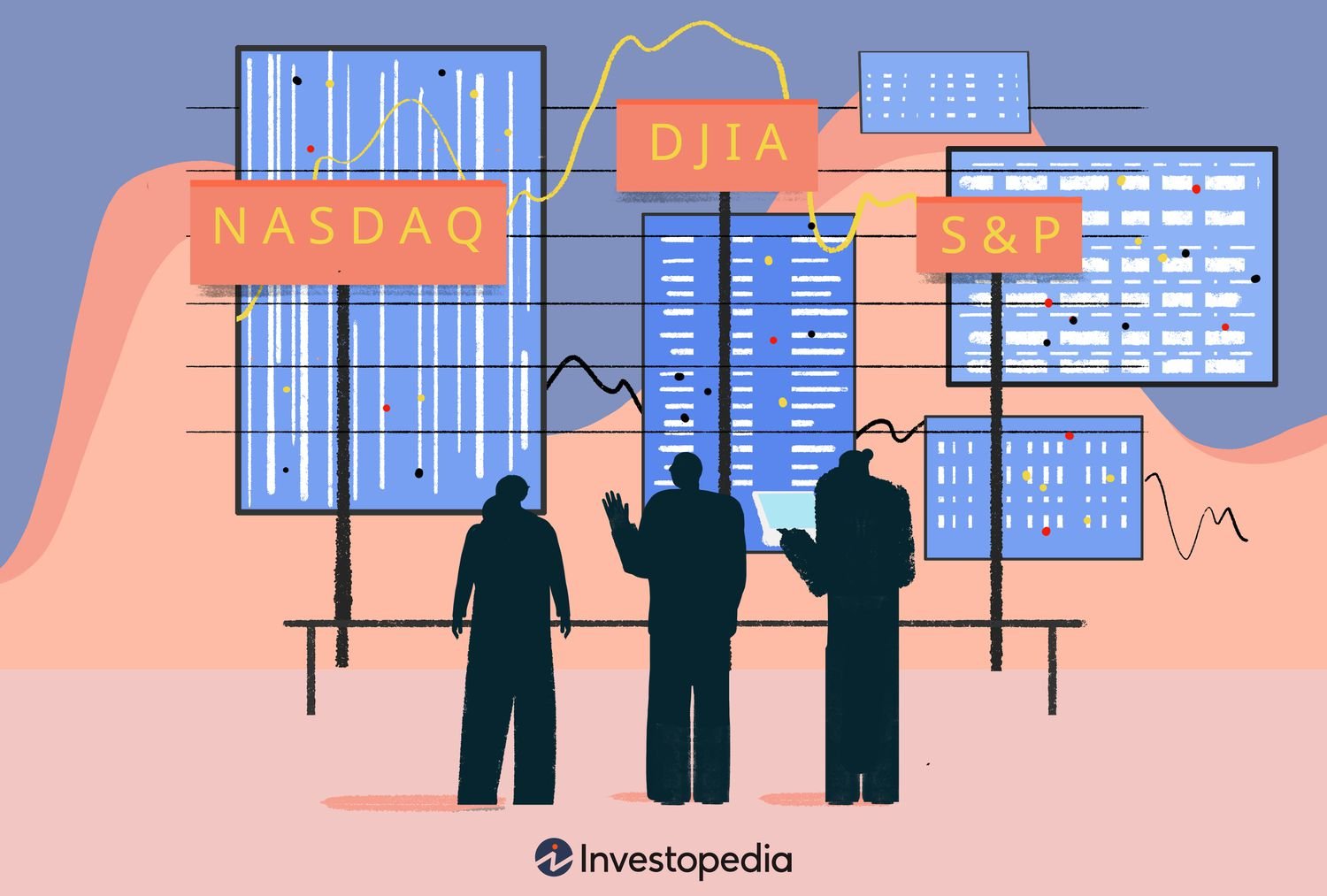
Michela Buttignol / Investopedia The Dow Jones Industrial Average, the S&P 500, and the Nasdaq Composite each offer a view of the U.S. economy and the stock market, serving as vital tools for investors, economists, and policymakers alike. The Dow, with its focus on 30 blue-chip companies, provides a quick snapshot of how America’s industrial titans are faring. As the oldest of the three, it carries historical weight and often captures headlines. The S&P 500, tracking 500 of the largest U.S. companies, offers a more comprehensive view of the American economy. Its market capitalization weighting gives more influence to larger companies, reflecting their outsized impact on the economy. Meanwhile, with its heavy tilt toward technology companies, the Nasdaq Composite serves as a barometer for innovation and growth sectors. Together, these indexes paint a picture of the U.S. economy:
While these indexes are prominent indicators, they don’t tell the whole story—certainly not when changes are looked at in terms of day-to-day point shifts. They exclude small-cap stocks, private companies, and other important economic indicators of the broader market and the economy. The Standard & Poor’s 500 Index, commonly known as the S&P 500, is an index comprising 500 of the top companies in the U.S. Stocks are selected based on market capitalization. The S&P 500 is not only chosen by market cap but also weighted by it. As such, when the total market value of all 500 companies in the S&P 500 drops by 10%, the value of the index also drops by 10%. Nevertheless, the constituent committee also considers other factors, including liquidity, public float, sector classification, financial viability, and trading history. Many of these stocks overlap with other indexes and compiled lists like the Nifty Fifty. The index is calculated by taking the sum of the adjusted market capitalization of all 500 stocks and dividing it by a proprietary divisor. The S&P 500’s role as the preeminent benchmark for the U.S. stock market is hard to overstate—it’s why it’s one of the first financial numbers you’ll see on any news site, not just financial platforms. Here’s why it’s so important:
Despite its importance, it’s crucial to remember that the S&P 500 isn’t without limitations. It excludes small-cap stocks and doesn’t pretend to represent the global economy. Nonetheless, its role as the primary benchmark for U.S. equities cements its place as a cornerstone of modern finance. The Dow Jones Industrial Average (DJIA), known as the Dow, includes the stocks of 30 of the largest and most influential companies in the U.S. The index is known for listing the U.S. market’s best blue-chip companies, covering all industries except transportation and utilities. The Dow is a price-weighted index, computed by totaling the per-share price of each company’s stock in the index and dividing this sum by the number of companies. Stock splits, spinoffs, and other events have resulted in changes in the divisor. The oldest index on this list—and among the oldest on Wall Street—its divisor was 16.67 in 1928. As of October 2025, it’s 0.16268413125742. Even though the Dow isn’t a snapshot of the broad market, it reflects the blue-chip industrials market. For example, while the SPDR Dow Jones Industrial Average ETF (DIA) tracks its performance, most other ETFs that include the DJIA are composed of a broader list of companies. A blue chip is a nationally or internationally recognized, well-established, and financially sound publicly traded company. Most investors recognize the Nasdaq as the exchange on which technology stocks are traded. The Nasdaq Composite Index is a market-capitalization-weighted index of all the stocks traded on the Nasdaq stock exchange and includes companies based outside the U.S. The index covers several subsectors across the tech market, including software, biotech, and semiconductors. Although a majority (more than 56%) of the index is composed of technology stocks, it also includes securities from the financial, industrial, insurance, and transportation sectors. The Nasdaq Composite includes large and small firms, but unlike the Dow and the S&P 500, it also holds many speculative companies with small market capitalizations. The movement of this index is taken as indicative of the performance of the technology industry and investors’ attitudes toward speculative stocks. Like the S&P 500, it has popular funds that track its performance: The FT Wilshire 5000 is sometimes called the “total stock market index” or “total market index” because it includes all publicly traded companies based in the U.S. with readily available price data. Defining an index depends on where the stocks fall in capitalization. Indexes can be large-cap, midcap, or small-cap. The S&P 500 and the Dow Jones Industrial Average are the top large-cap indexes. Notable midcap indexes include the S&P Mid-Cap 400, the Russell Midcap, and the Wilshire U.S. Mid-Cap Index. For small-caps, the Russell 2000 is an index of the 2,000 smallest stocks from the Russell 3000. The growth of smart beta index investing has helped increase the number of indexes in the market. Unlike traditional index funds, which track market-cap-weighted indexes, smart beta approaches use alternative weighting strategies based on volatility, dividends, earnings, or other fundamental metrics. The goal is to improve returns, broaden diversification, or reduce risk compared with conventional indexes. Indexes play an important part in the overall analysis of the U.S. equity market. Indexes and their movements provide insight into the economy, investor sentiment, and trends for investing diversification. The Dow Jones Industrial Average, the S&P 500, and the Nasdaq Composite have earned their status as the top three U.S. stock market indexes through a combination of historical significance, market representation, and adaptability to changing economic times. With its long history and recognizable brand, the Dow continues to capture public attention and often drives market narratives. The S&P 500, with its broader representation and status as the go-to benchmark for professional investors, provides a more comprehensive view of large-cap U.S. equities. The Nasdaq Composite, with its tech-heavy composition, helps gauge the growth sectors that often drive market news. As such, each index offers its own lens through which to view the U.S. stock market and, by extension, the American economy. (责任编辑:admin) |